
Gold vs Silver: The Core Difference
Investors buy gold because it is scarce, durable, globally recognized, and not issued by a government. If you want to own a stable form of money that sits outside of the traditional financial system, gold is the clear choice.
Silver has a monetary history too, but modern silver demand is tied more heavily to industrial and technological applications.
We can split gold and silver demand into 3 categories:
- Jewelry
- Industry (Electronics, Medical)
- Investment/Reserves (Central Bank Purchases, Bars and Coins, ETFs)
In the last 5 years (2021-2025), total gold demand reached 48,880.7 tonnes. Total silver demand reached 183,423.4 tonnes.
Total Gold Demand
48,880.7 tonnes
| Category | Tonnes | Share |
|---|---|---|
| Jewelry | 20,425.7 | 41.8% |
| Industry | 3,258.5 | 6.7% |
| Investment | 25,196.6 | 51.5% |
Total Silver Demand
183,423.4 tonnes
| Category | Tonnes | Share |
|---|---|---|
| Jewelry | 31,865.5 | 17.4% |
| Industry | 111,142.1 | 60.6% |
| Investment | 40,415.9 | 22.0% |
Sources: World Gold Council (Historical demand and supply); The Silver Institute (Silver Supply and Demand table, converted to tonnes)
Silver demand is larger by weight because silver is so much cheaper per ounce. However, in dollar value, gold demand is significantly larger.
That is the cleanest way to frame the difference: the gold market is led by investment and central-bank buying; the silver market is led by industrial fabrication.
Why Gold Plays the Foundation Role
If silver is useful in more industrial applications, why would gold be the more durable foundation for an investment portfolio?
There are several reasons. First, gold’s lack of industrial dependence is part of its appeal. It serves as money and not much else.
Nearly every major modern currency originally rose to prominence while linked to gold. The U.S. dollar, British pound, French franc, German mark, and many other currencies were either directly redeemable in gold or backed by gold reserves under the international gold standard system. Gold provided credibility, stability, and a universally recognized settlement asset between nations.
Central banks hold gold today for the same reasons they originally used it to back their currencies. Gold is scarce, globally recognized, durable, and independent of any single government’s monetary policy. Its value does not depend on the decisions of any government or any counterparty’s ability to pay their debts.
The WGC estimates that central banks collectively own about 18% of all gold ever mined: 36,616 metric tons (worth $5.4 trillion at today’s prices).
Central bank holdings provide a strong demand anchor that stabilizes the market over the long run.
Gold also has high value density. Gold can be stored more compactly than the same dollar value of silver. This makes storage, shipping, insurance, and custody cheaper for physical investors.
Why Investors Buy Silver
Silver’s volatility can be a weakness, but can also be its greatest strength.
Silver moves more aggressively gold, both to the upside and downside. A smaller market, lower price per ounce, and industrial demand cycle all amplify silver’s moves.
It also feels accessible. An investor can buy one-ounce silver coins or small bars with a lower upfront dollar amount than any gold product. (This does not make silver cheaper in an economic sense. Premiums, spreads, and storage costs are usually higher.)
Silver’s biggest advantage over gold is its future industrial outlook. It has the highest electrical conductivity of any metal, making it essential in electronics and high-performance computing. Demand is growing in three of the fastest-growing global industries:
- Solar: Silver is a core input in photovoltaic cells.
- Electric vehicles: EVs require significantly more silver than internal combustion cars due to power electronics, battery systems, and charging infrastructure.
- AI + data centers: The buildout of AI infrastructure (chips, servers, high-bandwidth memory) is accelerating demand for silver in semiconductors
These sectors will growing for decades. Each year, silver will become more important to our economy.
Small Market, Big Moves
Silver is mostly produced as a byproduct of other metals (lead/zinc, copper, and gold).
This creates a unique supply problem. When silver demand rises, the mining industry cannot quickly increase silver production in response. New supply comes to market slowly, even during periods of sharply rising demand.
This matters because silver has a comparatively small physical market relative to global financial assets and industrial demand. When investors and companies start buying physical silver, available supply quickly dries up.
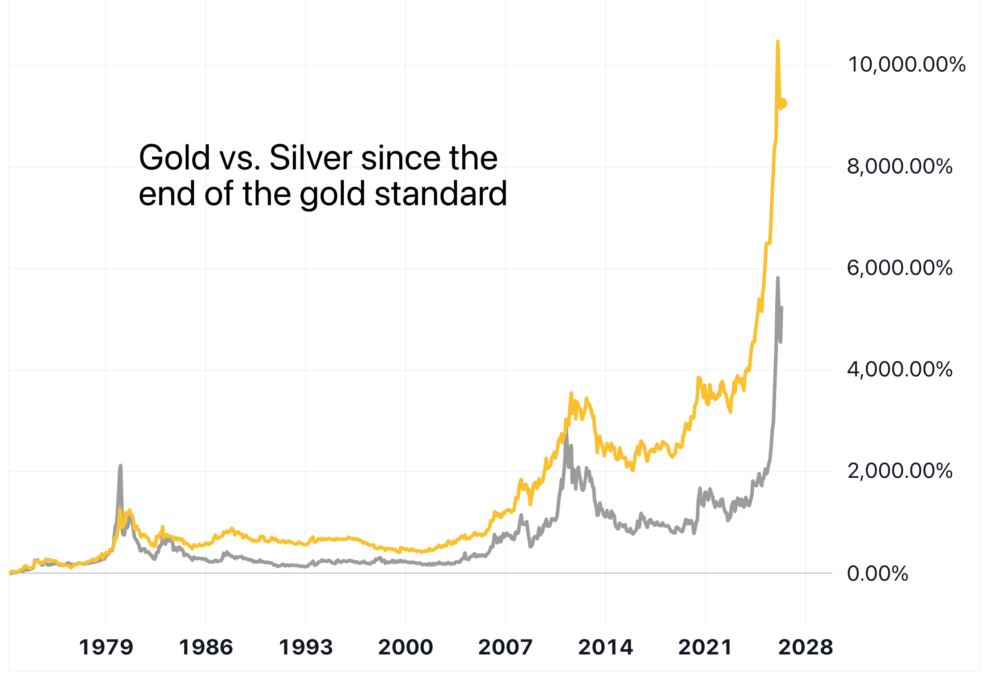
That imbalance explains why silver experiences explosive price moves (some of the largest percentage moves in the commodities market). Small shifts in demand have an outsized impact on price.
Silver also attracts speculative capital during precious metals bull markets. Gold usually moves first as investors seek monetary safety. Once confidence and momentum build, capital flows into silver because it is a smaller, more volatile market with greater upside sensitivity.
Gold vs Silver Investment Products
What specific products should I buy?
Bullion Coins
Government-minted bullion coins are the most recognizable precious metals products.
- Gold: American Gold Eagle, Canadian Gold Maple Leaf, South African Gold Krugerrands
- Silver: American Silver Eagle, Canadian Silver Maple Leaf, South African Silver Krugerrands
Bullion Bars
Bars are the lowest-premium way to buy precious metals. Typical sizes include:
- Gold: 1 oz bars, kilo bars, 400 oz London Good Delivery bars
- Silver: 10 oz bars, 100 oz bars, 1,000 oz London Good Delivery bars
Junk Silver
“Junk silver” refers to pre-1965 U.S. coins containing 90% silver, such as:
- Morgan Silver Dollar
- Peace Dollar
These products are unique to silver investing. Investors buy junk silver because the coins are recognizable, divisible, and useful in smaller transactions. During periods of financial stress, junk silver premiums often rise sharply due to retail demand.
ETFs
Investors can buy indirect exposure to precious metals through ETFs like:
- SPDR Gold Shares
- iShares Silver Trust
The Gold/Silver Ratio
Every commodity investor knows about the “gold/silver ratio.”
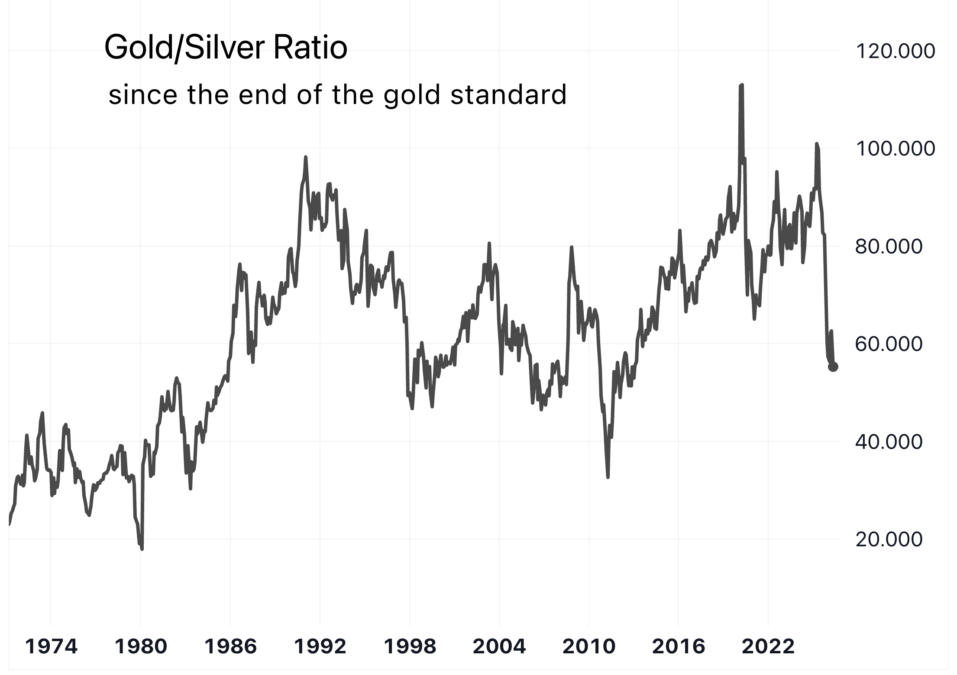
The gold/silver ratio divides the price of gold by the price of silver. If gold is $5,000 per ounce and silver is $50 per ounce, the ratio is 100. In plain English, it takes 100 ounces of silver to buy one ounce of gold.
Investors watch the ratio because it shows how expensive one metal is relative to the other. A high ratio means gold is expensive relative to silver. A low ratio means silver is expensive relative to gold.
Use the ratio as a context tool. If the ratio sits far outside its historical range, it can tell investors to allocate their portfolio more heavily to one metal or the other.
Which Is Better for Long-Term Investors?
- What problem are you trying to solve? Gold is the better starting point for investors who want precious metals as a long-term foundation. If you want a more aggressive complement, silver deserves a look.
- Where is the gold/silver ratio? Track the gold/silver ratio (or speak to a professional precious metals advisor) to determine which metal is undervalued compared to historical averages.
- How much volatility can you tolerate? Silver tends to moves sharply in both directions. Gold has historically been the steadier of the two metals.
- How will you store it? Gold has higher value density. Silver takes more space and weight for the same dollar value.
- What costs apply? Silver typically carries higher premiums, wider buy/sell spreads, and higher storage costs as a percentage of its value. However, these costs vary significantly by the type of coin or bar. Always compare a product’s premium to the underlying spot price before purchasing.
- Do you understand the demand drivers? Gold demand is led by investment and central-bank buying. Silver demand is led by industrial fabrication.
- Are you buying metal or exposure? Physical metal, ETFs, mining stocks, and futures all behave differently. Know what you own before deciding how much to own.
Buy physical gold and silver without the excessive fees
If precious metals are meant to serve as the foundation of your portfolio, ownership structure matters. Vaulted helps investors buy allocated physical gold and silver in a professional vault.