
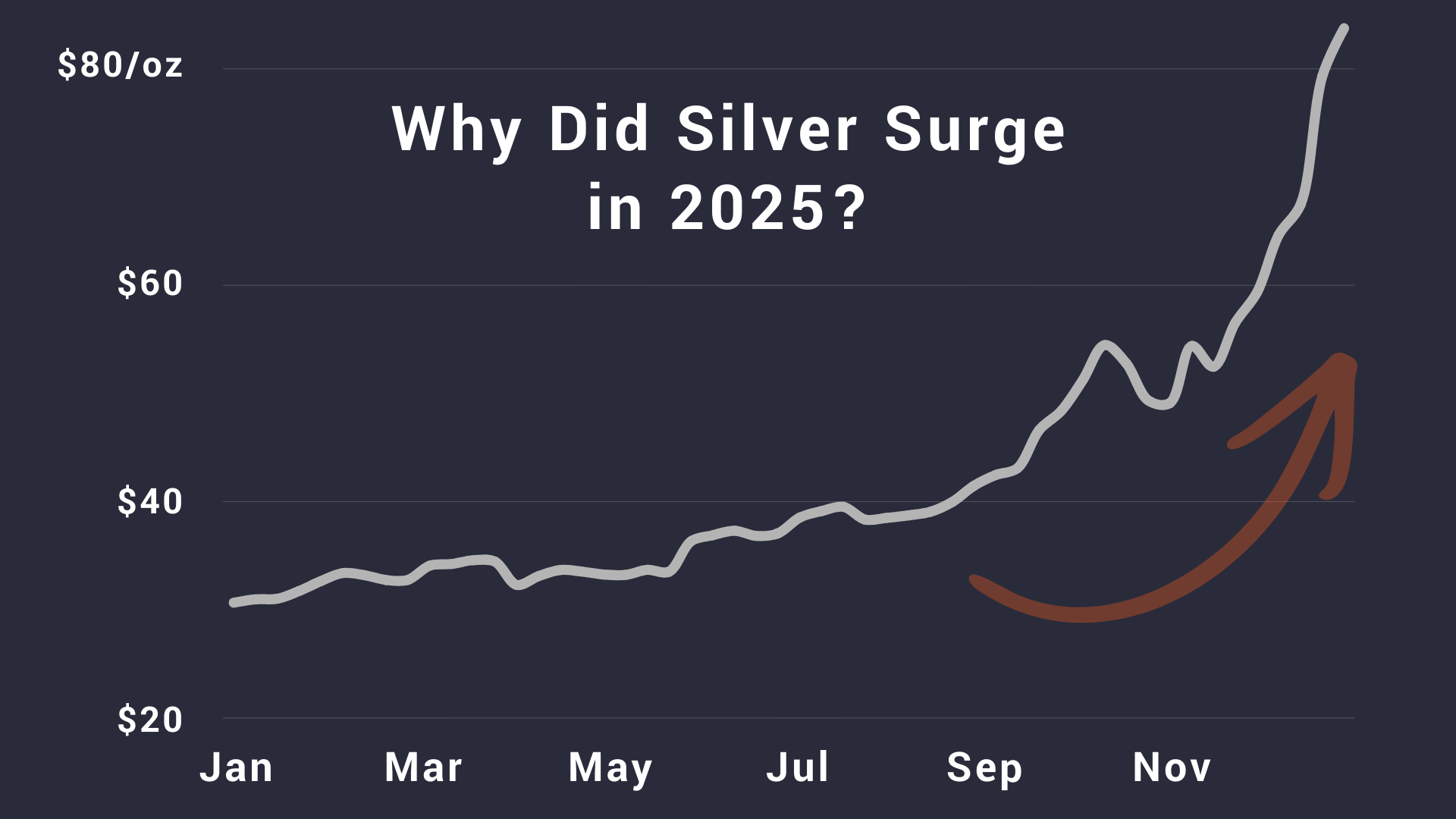
This kind of move comes from a combination of forces that all pushed in the same direction:
- a multi-year physical silver deficit that finally hit prices,
- industrial demand that kept growing (solar panels + electronics + AI),
- inelastic supply (because silver is mostly mined as a byproduct of other metals),
- tight inventory / liquidity (the physical metal isn’t easily deliverable),
- unwinding short positions added fuel to the fire,
- macro tailwinds (geopolitical risk, weaker U.S. dollar, rate cut expectations), and
- investment flows (ETFs + retail) that turned a tight market into a self-reinforcing price surge.
1) The deficit of physical silver
Silver has been running structural deficits for several years: the world has been consuming more silver than it produces (supply from mining + recycling). According to data from the Silver Institute, silver demand has exceeded supply every year since 2019.
A deficit can persist for a while if it’s covered by “above-ground” inventories (inventory in vaults and private stockpiles). But deficits have a way of turning into price shocks when investors show up and demand physical delivery now.
When available silver inventory can no longer balance the market, the price becomes the only release valve. It has to rise far enough to decrease demand and encourage increased supply. Historically, that has meant rapid moves of 100, 200, or 300% (or more).
2) Industrial demand for silver
Roughly half the silver market is industrial. The recent surge in industrial demand is tied to electrical grid investment, electric vehicles, solar panels, and AI.
Solar energy
Since 2022, the International Energy Agency (IEA) has warned that the “rapid growth” of silver demand, “combined with long lead times for mining projects, increases the risk of supply and demand mismatches, which can lead to cost increases and supply shortages.”
The IEA’s 2025 Global Energy Review states that adding more photovoltaic (PV) solar capacity is the main way the world is keeping up with rising electricity demand. Even if PV manufacturers figure out a way to use less silver per solar panel, the overall increase will still drive huge net demand for silver.
Electronics + AI
Silver is required to produce high-reliability electrical contacts, solders, and specialized electronics. The Silver Institute explicitly points to AI-related end uses as a contributor to industrial demand growth.
Bottom line: The future is built on silver.
3) Silver supply is inelastic
If the oil price triples, rigs show up. If copper spikes, producers scramble to start new mining projects. Silver is different.
Roughly 70% of silver output is byproduct from mining lead/zinc, copper, and gold. This means silver supply depends heavily on the economics of other metals. You can’t just “turn on” primary silver production quickly. (See this USGS report for details.)
When demand tightens, the market can’t quickly solve it with new metal. Price has to do the heavy lifting.
4) Liquidity stress and tight inventory
When markets get tight, the “plumbing” starts making noise: lease rates jump, spreads widen, physical delays show up, and traders pay a premium for nearby metal.
COMEX deliverable stocks are finite (and watched like a hawk)
CME publishes daily statistics on how much silver is sitting in approved COMEX vaults.
In a real squeeze, the important question isn’t “how much silver exists in the world?” It’s “how much is available for delivery right now at the main trading venues?”
Most silver is already spoken for by long-term holders. When the pool of readily available silver is small, even modest demand can force prices sharply higher.
Lease rates: the “I need metal now” signal
In 2025, the cost to borrow physical silver (the lease rate) was unusually high relative to gold. Rising lease rates mean people need silver urgently and vault owners are reluctant to lend it. Refiners, traders, and bullion banks picked up on this signal.
According to LBMA analyst Bruce Ikemizu, silver’s liquidity problems “could flare up any time again in 2026 as the lease rate remains at a much higher level than gold. Political moves regarding silver, critical mineral status by the U.S. and export limitation by China add the fuel to the liquidity problem.”
5) Silver is massively shorted
Silver has always had a lot of short positions (bets that the price will fall). That’s because:
- big industrial users and traders use the futures market to hedge, and
- silver is a relatively small market where leveraged trading is common.
Large short positions didn’t cause the rally, but they did magnify it.
As physical silver got harder to source and money started pouring into the market, those paper bets against silver became more expensive to maintain. Traders were forced to reduce or close their shorts, which meant buying silver back. That buying pressure pushed prices even higher, adding fuel to an already tight market.
If you want data on short positions on gold and silver, the CFTC’s Commitments of Traders data is the canonical source for futures positioning.
6) Macro tailwinds
Silver rarely starts the party; it shows up late and flips the table.
Throughout 2025, gold surged to record highs amid geopolitical uncertainty, a weaker U.S. dollar, and expectations for rate cuts—classic tailwinds for precious metals.
Silver caught the same macro wave as gold, but outperformed because the market is smaller, thinner, and more reflexive.
7) Momentum
Once silver started breaking highs, money followed performance.
Reuters reports record recent inflows into silver ETFs, citing Vanda Research: nearly $922M into silver-backed ETFs in 30 days.
ETF.com also described a sharp reversal from years of outflows to inflows as silver broke out.
CME even announced new 100-oz silver futures “to meet record retail demand.”
When flows hit a physical-backed ETF, someone has to source the metal (or at minimum, hedge aggressively). This tightens liquidity further, raises lease rates, and pushes prices higher.
Vaulted: Real gold and silver without the excessive fees
With Vaulted, you can buy and hold physical gold and silver with just a few taps.
Table: Silver Prices in 2025
| Open | High | Low | Close | |
| Jan 25 | 28.89 | 31.73 | 28.89 | 31.30 |
| Feb 25 | 31.30 | 33.39 | 30.69 | 31.12 |
| Mar 25 | 31.14 | 34.58 | 31.13 | 34.09 |
| Apr 25 | 34.09 | 34.21 | 28.34 | 32.57 |
| May 25 | 32.58 | 33.70 | 31.66 | 32.98 |
| Jun 25 | 32.98 | 37.31 | 32.96 | 36.07 |
| Jul 25 | 36.08 | 39.52 | 35.81 | 36.69 |
| Aug 25 | 36.70 | 39.97 | 36.37 | 39.69 |
| Sep 25 | 40.71 | 47.17 | 40.15 | 46.66 |
| Oct 25 | 46.59 | 54.47 | 45.56 | 48.66 |
| Nov 25 | 48.63 | 56.53 | 46.88 | 56.40 |
| Dec 25 | 56.50 | 83.76 | 56.19 | 71.61 |